Showing posts with label Tech News. Show all posts

Google, Facebook were dominant websites in 2011

Wednesday, January 04, 2012
Computerworld - Online giants Google and Facebook came out as the most-visited websites of 2011, according to a Nielsen report.

Meanwhile, Yahoo, which has struggled with corporate and financial problems, was the third-most-visited website, trailing behind second-place Facebook.

The Nielsen study showed that Google was the most-visited website in 2011, with an average of more than 153 million unique visitors per month. Facebook was second with more than 137 million, and Yahoo was third with 130 million.

Microsoft sites, including MSN, Windows Live and Bing, came in fourth with nearly 116 million unique monthly visits. Google-owned YouTube rounded out the top five with more than 106 million visits.

"I'm surprised at how close the top four are," said Ezra Gottheil, an analyst with Technology Business Research. "I think it reflects the fact that many people visit several [sites], or all of them." The list also shows how valuable Yahoo still is despite the corporate problems the company experienced in 2011.

Yahoo, which has fallen from its once lofty position as an Internet pioneer, has been in a state of flux. This past September, with revenues falling and some top talent leaving, Yahoo's board of directors fired then-CEO Carol Bartz.

Once Bartz was out, speculation bloomed that Microsoft, which made a failed bid for Yahoo back in 2008, is once again looking to scoop up Yahoo. And then talk began that Google, possibly just to keep Yahoo out of Microsoft's clutches, was also interested in buying Yahoo.

Gottheil noted that even though Yahoo is in a state of flux, it's still drawing in a large number of users. "Most people don't stop using something that works for them," he added. "They might add another service, but that doesn't mean they eliminate an old one."

For social networks, Facebook was the top dog in 2011 with more than 137 million unique visitors per month, according to Nielsen. Blogger.com came in a distant second with nearly 46 million, and Twitter was in third place with more than 23 million. WordPress, with more than 20 million, and MySpace, with nearly 18 million, rounded out the top five.

Google's new social network, Google+, was in the eighth spot, even though it didn't launch until late June.

While some may have expected Google+ to grab a higher spot on the social networking list, Gottheil said the new network could just be slowly ramping up.

"Google+, for a lot of people, just has not been sticky enough," he added. "That doesn't mean it won't eventually develop a larger loyal following, but one of the consequences of Google's big intro was that many of its original users were just window-shopping. Facebook, for all its recent rapid growth, built up gradually ... It's the network effect. Each additional user increases the value of the service to every other user."

How To Run Playstation 2 Games In PC

Sunday, November 13, 2011
PCSX2 is an open-source PlayStation 2 (PS2) emulator for the Microsoft Windows and Linux operating systems. In its latest stable release, many PS2 games are playable, and several games have full functionality.The main bottleneck in PS2 emulation is emulating the multi-processor PS2 on a PC x86 architecture. Although each CPU can be emulated well, accurately synchronizing the CPUs is very difficult.

PCSX2, like its predecessor project PCSX, is based on a plug-in architecture, separating several functions from the core emulator. These are the graphics, audio, input controls, CD/DVD drive, and USB and FireWire (i.LINK) ports. Different plug-ins may produce different results in both compatibility and performance. Additionally, PCSX2 requires a copy of the PS2 BIOS, which is not available for download from the developers, due to the copyright concerns and legal issues associated with it. The emulator is incompatible with PlayStation games.

When PCSX2 was first developed it could only run simple homebrew applications. Speed prior to version 0.9 was between 2 and 15 frames per second depending on the game, PC hardware, and plug-in configuration―with the PS2 BIOS itself being one of the fastest pieces of software to emulate. Since the release of version 0.9 in April 2006, performance has greatly increased. Most 2D games and menus can reach 60-120 frame/s when specific plug-ins are used, and with the latest version, it is possible to reach speeds greater than the native PS2 frame rate of 60 frame/s (NTSC) and 50 frame/s (PAL). In version 0.9, PCSX2 also added support for dual-core CPUs, resulting in a very significant performance increase on systems with dual-core processors. As of beta build r4865, the MTVU (Multi-Threaded microVU1) speedhack has been implemented, which offers a speedup in many games for systems with 3 or more cores.

System requirements

Following is a short list of system requirements for running PCSX2
Minimum
Windows XP Service Pack 2/Windows Vista or Linux 32bit/64bit
CPU that supports SSE2 (Dual Core and up, Athlon64 and up)
GPU that supports Pixel Shader 2.0
1GB RAM

Recommended (Will run 50-60fps)
Windows XP, Vista, 7 or Linux 32/64 bit
CPU: 3Ghz Core 2 Duo or better
GPU: Nvidia GeForce 9600gt or Better
2GB RAM (3GB or more if using Windows Vista or Windows 7)

To download PS2 Emulator bios Go To www.Torrentz.com and search ps2 games or games ps2. Now you can download it..

Enjoy !!!

UCWeb 8.0 browser for Android phones launched in India

Thursday, November 10, 2011
UCWeb, a Chinese mobile browser maker, has launched the UCWeb 8.0 browser for the Android phones. As the firm points out, the browser compresses mobile data usage by up to 90 percent thus allowing users to save on their data bills. The earlier versions of this browser are compatible with platforms such as Symbian, Android, iPhone, Java, MTK and Brew. The company also mentioned that the UCWeb browser has been downloaded for about 1 billion times worldwide with over 200 million users. Currently UCWeb is the second most popular mobile browser in Indonesia, Russia and India right after Opera, which holds the top position. “We are looking to reach out 100 million users in India by 2015,” said UCWeb Director for International Strategic Cooperation, Robert Tanner.

The number of public Wi-Fi hotspots is expected to increase by 350% in the next four years

The number of public Wi-Fi hotspots is expected to increase by 350% in the next four years, as operators look for ways to offload traffic from their mobile networks, according to a report by market research company Informa Telecoms and Media.
By 2015, users around the world will be able to connect to 5.8 million public hotspots, Informa wrote in the "Global developments in public Wi-Fi" report, which was commissioned by Wireless Broadband Alliance. WBA members include AT&T, Boingo, Cisco Systems, Deutsche Telekom and Google. Its goal is to make Wi-Fi services easier to use.
Mobile data growth is a key reason for the rapid build-out of Wi-Fi hotspots, according to Informa. On Monday, telecom equipment vendor Ericsson published a report which contends that mobile data traffic will grow tenfold in 2G, 3G and 4G networks between 2011 and 2016.
To handle the growth, operators will have to use a number of different technologies, including Wi-Fi, LTE (Long Term Evolution) and traffic shaping, according to Thomas Wehmeier, principal analyst at Informa.
Users don't care about acronyms like 3G, 4G or Wi-Fi, as long as their network connection works well, according to the WBA.
However, to increase usage, hotspots also have to become easier to use. Operators and vendors are working on integrating mobile networks and Wi-Fi hotspots more closely, including using SIM cards to simplify the log-in procedure and roaming between different networks.
The Wi-Fi Alliance is next year planning to launch a certification program that will offer standardized mechanisms for discovery, authentication and provisioning. The program will be based on its Hotspot 2.0 specification, which also used by the Wireless Broadband Alliance as it trials next-generation hotspots. In June, the two organizations said they will cooperate on developing hotspots.
But the buildout of Wi-Fi hotspots isn't just about offloading data. Telefonica is using Wi-Fi to build a location-based services and earlier this year hotspot provider The Cloud was acquired by British Sky Broadcasting Group, which is mostly known for its satellite TV services.
The report also highlights the proliferation of smartphones, which will soon overtake laptops as the most popular way to connect to hotspots. Globally, smartphones account for 36% of all connections, compared to 48% for laptops and 10% for tablets. However, in North America smartphones already outnumber laptop connections, according to Informa.
Informa defines public hotspots as a place that offers Internet access to all members of the public, either for a fee or for free. The report excludes 4.5 million community hotspots, where consumers today share their broadband connection with others using equipment from Fon.

Cisco posts small revenue gain

Cisco Systems has completed most of a major restructuring that began early this year, and on Wednesday posted revenue and profit for its fiscal first quarter that exceeded analysts' expectations.

For the quarter ended Oct. 29, Cisco reported revenue of US$11.3 billion, up 4.7 percent from a year earlier, and net income of $1.8 billion, or $0.33 per share. Earnings per share fell 2.9 percent from the year earlier.

Not counting certain one-time items, Cisco had net income of $2.3 billion, or $0.43. The results were in line with the consensus of expectations from analysts polled by Thomson Financial, who forecast earnings of $0.39 per share on revenue of $11.02 billion.

The report was the first since Cisco set a new long-term growth forecast at a financial analyst conference in September. The company now expects between 5 percent and 7 percent annual revenue gains over the next three years, following several quarters of disappointing results and a major reorganization. It expects earnings per share to increase between 7 percent and 9 percent per year.

In a press release on Wednesday, CEO John Chambers said a majority of the company's reorganization was complete.

In its fiscal fourth-quarter report released in August, Cisco had posted a drop of more than one-third in net income and an increase of only 3.3 percent in revenue from the year-earlier quarter.

Since early this year, the company has moved to sharpen its focus on five key areas of its business: core routing and switching, collaboration, data-center virtualization, video, and tying these elements together in an overall architecture.

For the current fiscal quarter, Cisco expects revenue to grow between 7 percent and 8 percent.

On a conference call with financial analysts after the report, Chambers painted the results as proof Cisco is executing well on the plans outlined at the September conference.

"Our strategy and vision outlined in our three-year plan is taking hold and off to a very good start," Chambers said. The company said it is on track to complete all the cost-cutting it has planned by the end of the third quarter of this fiscal year.

Asked about Huawei Technologies' recent move to establish sales channels for its enterprise-network equipment in the U.S., Chambers said China's largest networking vendor is a long-term threat here. Cisco already calls Huawei its biggest rival worldwide in the next few years.

"We're going to make it very hard on them in the U.S.," Chambers said. "They're going to be around four to five years from now."

Total switching orders grew 10 percent, with flat revenue, and routing orders went up 7 percent, with revenue down slightly. But Cisco's fledgling data-center business, built around its UCS (Unified Computing System) server platform, grew 122 percent in orders and 116 percent in revenue, Chambers said. In the first quarter, Cisco gained 1,572 new UCS customers, bringing the total to 8,983, he said.

iPhone manufacturer to start making robots soon

Wednesday, November 09, 2011
Foxconn, one of the world’s largest contract manufacturers that makes many Apple products including iPhone and iPad, had in August revealed its plans to hire a million robots in its assembly plants in the next three years. The move was then seen as a measure to counter growing labor costs and increase productivity at the same time. But little did anyone realize back then that Foxconn planned to manufacture those robots on its own. Yes, the manufacturer of some of the most popular gadgets will soon be manufacturing robots at a plant it is building in Taiwan. The ground breaking ceremony for the facility was held last week and Foxconn is looking at robots as one more thing it can sell (it sees great opportunity in hospitals).
Well, do we see an Apple-branded robot coming soon? Highly unlikely. A Chinese version of ASIMO? Very much possible. However, before we jump the gun, the first robots rolling (marching?) out of that factory are more likely to be assembly line machines, whose resemblance to Arnold Schwarzenegger would be limited to the fact that both have arms. But yes, this new business line could have the potential to form a sizable chunk of Foxconn’s revenues as its margins in making shiny gizmos are squeezed in coming years.

Innovation: TV networks to become social networks

Monday, November 07, 2011
What will your TV look like in five years' time? The screen in your living room may be about to be transformed by the union of television broadcasting and online social networking.

This week, Google's chief Eric Schmidt announced that in the next month or so Google TV will go live in the US.

Google joins a host of other internet companies that want to transform our viewing habits by integrating TV with interactive web features. So far, all have failed. The trouble is, services like Apple TV and Roku tend to allow us only to stream stuff on-demand from the internet, but without any live TV. Others, such as TiVo and Microsoft, provide live TV, but with only limited access to the web. Google claims it will bring together live TV and unfettered access to the web for the first time.

Yet many researchers and tech analysts say the most profound change to our TV habits will come via technology that allows us to share and socialise via our screens. The winners of the battle for digital domination in our living rooms, they argue, will be those who work out how to draw on the success of social networks such as Twitter and Facebook. New Scientist has spoken to some of the activists of this potential social TV revolution to get a glimpse of what will be on the box tomorrow.
Goal!

The premise of social TV is simple: allow people to easily share and discuss the shows they are watching, no matter where they are – be it recommending the next episode of True Blood or participating in a goal celebration.

Some people think of TV viewing as a solitary experience. But, says Marie-José Montpetit at the Massachusetts Institute of Technology, who is developing an experimental social TV system called Nextream, ever since the birth of TV we have been talking to each other during broadcasts. And now we're using online social networks in the same way. "The Twitter servers were brought down by the World Cup because people were exchanging views about it," she says.

Social TV could soon usurp TV guides, because the huge number of channels is so overwhelming to navigate, says Greg Goldman of Philo, a social TV application launched in July.

According to a 2008 study by consultancy Parks Associates, based in Dallas, Texas, 20 per cent of people in the US want TV recommendations from friends and to chat with fellow viewers. What's more, a quarter of them are happy to share the stuff they watch.

Internet responsible for 2 per cent of global energy usage

How much energy does the internet use? It's hard to know where to start. There's the electricity consumed by the world's laptops, desktops and smart phones. Servers, routers and other networking equipment suck up more power. The energy required to manufacture these machines also needs to be included. Yet no one knows how many internet-enabled devices are out there, nor how long they are used before being replaced.

That hasn't stopped Justin Ma and Barath Raghavan from trying to answer the question. The pair, researchers at the University of California, Berkeley and the nearby International Computer Science Institute respectively, estimate that the internet consumes between 170 and 307 GW. Which, of course, raises another question: is that is a big number, or a small one?

Raghavan and Ma came up with their total by conducting a rough internet census. By drawing on previously published research, they estimate that our planet is home to 750 million laptops, a billion smart phones and 100 million servers.

They also put figures on the energy that it costs to produce each of these devices (4.5 GJ and 1 GJ for a laptop and smartphone respectively) and the period for which each is used before being replaced (three years for a laptop, two for a smart phone). Estimates for the energy that cell towers and optical switches use when transmitting internet traffic, plus similar calculations for wi-fi transmitters and cloud storage devices, helped complete the picture.

Their final answer sounds big. A gigawatt is a billion watts, so running and maintaining the internet is like illuminating several billion 100W bulbs simultaneously. But it's a small number compared with global energy use across all sectors. That figure is 16 terawatts, so the internet is responsible for less than 2 per cent of the energy used by humanity.

Raghavan and Ma suggest that attempts to create more energy-efficient internet devices, while worth pursuing, will not do much to lower global energy consumption. Instead, they propose that we should think about how the internet can replace more energy-intensive activities. Their calculations show that a meeting that takes place by video-conference uses an average of one hundredth as much energy as one in which participants took a flight so that they could sit down together. Replacing just one in four of those meetings by a video call, they add, would save as much power as the entire internet consumes.

How innovative is Apple's new voice assistant, Siri? IT LETS you check the weather or make an appointment simply by asking aloud

IT LETS you check the weather or make an appointment simply by asking aloud, but is Siri, the "personal assistant" on Apple's newly released iPhone 4S, really such an advance?

Yes, says Boris Katz, an artificial intelligence (AI) researcher at MIT. He says Apple has created a "very impressive piece of engineering" by combining established techniques from fields such as voice recognition and natural language processing.

Phil Blunsom, who researches machine learning at the University of Oxford, stresses that Apple hasn't just put together existing techniques. But he has reservations: "The difficulty is that each one of these systems makes errors, and when they are fed into each other the errors multiply."

Apple won't talk about Siri's underlying technology, though a patent application it filed earlier this year reveals that the software manages these errors by restricting queries to specific areas like dining or the weather. Apple calls such themes, for which Siri has access to databases of information, "active ontologies". For example, the dining ontology contains databases of restaurants, cuisines and dishes, along with information on the concept of a meal - that it involves one or more people gathering to eat.

The active ontology idea is not new - Tom Gruber, one of the inventors of Siri, formally defined it in 1995. What is unusual about Siri is that, unlike earlier grand AI projects, it is "very specifically focused on helping in particular domains", says Philip Resnik, a computational linguist at the University of Maryland in College Park. "If you go out of those domains, all bets are off."

Siri listens out for keywords such as "Mexican" or "taco" to identify the subject area. It also works out whether to prompt for more information - such as what time to book a table - or whether it has enough details to access a reservations website and make the booking. This final step is possible because most web services now offer application programming interfaces (APIs) that let apps feed information to them. "That's one of the reasons Siri is possible now when it wouldn't have been five or 10 years ago," says Resnik.

The ability to make sense of requests phrased in ordinary language sets Siri apart from competitors such as Android's Voice Actions, which requires commands in a certain format - saying "navigate to" will elicit directions, but "how do I get to... ?" will not. It doesn't look as if Google is planning a Siri competitor yet. "I don't believe that your phone should be an assistant," said Andy Rubin, who heads Android development at Google, last week.

Siri will only get better. All queries users put to it are processed by Apple's servers, giving the company a wealth of data it can use to improve the app. Katz suggests Apple could mine this data to discover commonly asked questions that Siri cannot yet handle. That's simple enough, but what about asking it to "book a meal for my family when we're all available"?

"Siri 2 might involve taking advantage of the fact that many of the tasks you attempt to solve have a social aspect to them," says Resnik. So, for example, the Siris on your family members' iPhones could all work together to organise the meal.

Blunsom says Apple must try to keep expectations realistic, otherwise people might dismiss Siri because it "can't answer esoteric questions, despite the fact that it can find you a good sushi restaurant nearby".

Visual tour: 10 Google+ tips for beginners, Check out these 10 tips to get you started on Google's new social network.

Wednesday, July 13, 2011

You just got your hands on a Google+ invite -- but what next? Check out these 10 tips to get you started on Google's new social network.

Google+

Hands-on: Belkin N750 DB router extends your Wi-Fi's reach

Belkin N750 DBI tend to resist interim technology tweaks. For example, I'm still using a Linksys WRT600N wireless router from the dawn of the 802.11n age. (Can it be three years already?) There are a few hard-to-reach spots in the house, but it's been running 24/7 and it still works.
However, I've recently added a Samsung Galaxy Tab tablet to my array of Net-connected devices. Usually used in a room on the south side of the house, it routinely requires 3G to access the Internet because my Wi-Fi simply doesn't reach that far. Likewise, a computer in another room needs a 5GHz access point to connect reliably with the Linksys router. It's time to upgrade.
The Belkin N750 DB router

How To: Stop Receiving Emails From Facebook

Monday, July 11, 2011
fb-email-stop
fb
Facebook email notifications are really irritating. You can easily opt-out from those email by simply un-subscribing.
How To Unsubscribe From Facebook Email Notifications?
  • Open any email that came from facebook.
  • Click on Unsubscribe.
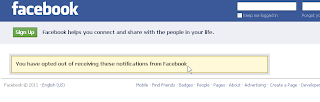
  • A new tab will open or asking confirmation. Check Opt Out and click Confirm.
    fb-email
  • You will get an unsubscription message.
    fb-optout
  • That's it, you won't receive any more emails from facebook.

How To: Enable Facebook Video Chatting

facebook-video-chatFacebook surprisingly introduced video calling feature on their most popular popular social networking website. You could start using facebook video chat now itself.


How To Enable Facebook Video Calling

  • Sign in to facebook.
  • Go to facebook.com/videocalling
  • Click on Get Started
  • Facebook will ask you to install an application on your pc. 
  • After installing the application, Click on any online friend and start video calling.
  • That's it. Ask your friends to install the facebook video calling app.
You can also send video message to your offline friends. 
I've just made a video chat with my friend. And it was really cool...
Read Facebook's blog post on video calling feature.

How To: Get Gmail's New Look

new-gmail-preview
Gmail team is working to make gmail better by changing the look of gmail interface. The upcoming gmail interface will be much simpler, cleaner, and modern looking. You can preview the new interface now.
gmail-dense-theme
How To Get Gmail's New Interface?
  • Sign in to Gmail.
  • Then goto themes section.
  • Then apply the Preview(Dense) theme.
new gmail preview
That's it. Enjoy the new and better gmail interface. 

Screenshot of new Gmail interface.

Biotech Industrial Training (BIPT) programme of Department of Biotechnology (DBT)2011-12 July 31, 2011- Last date for acceptance of applications

Friday, July 08, 2011
BIPT is a programme of Department of Biotechnology (DBT), Ministry of Science and Technology, government of India, managed by Biotech Consortium India Limited (BCIL). The objective of BITP is to provide practical industrial exposure for six months to students to improve job prospectus and to help biotech industry to identify prospective manpower.  During the training stipend @Rs. 8000/- per month is paid to trainees and bench fee is paid to companies to cover expenses towards training.  DBT invites applications from the biotech students and requisitions from the biotech companies. 

ATTN: Biotech Industry

NASA: Mother Nature may delay final shuttle launch

Mother Nature seems to be working against NASA launching its final space shuttle mission on schedule tomorrow.

The space shuttle Atlantis is scheduled to lift off from the Kennedy Space Center in Florida for its final voyage on Friday at 11:26 a.m. Eastern time. This won't just be the last mission for Atlantis. It also will be the final mission of the space shuttle program, which is being retired after 30 years.

The problem may be the weather.

First look: Google+ lets you hang with a small (or large) circle of friends

Google's Google+ social networking service, now out in a limited release, isn't the Facebook killer that Google no doubt hopes it will be. However, it's an innovative platform that takes a new approach to social networking by putting you in control of how you share with people. It also includes a number of intriguing features, such as one that makes it easy to ferret out content that interests you and share it with others.

Those who were put off by Google's previous failures in social networking, including Buzz and Wave, will be surprised at the usefulness and simplicity of Google+. It's a worthy enough product that you'd do well to sign up as soon as it's widely available.
The anti-Facebook

Facebook fires back at Google+ challenge

A little more than a week after Google unveiled its own social network, Facebook responded today with upgrades to its site, in an attempt to curb growing enthusiasm for the Google+ project.

After teasing last week that today's announcement was going to be "awesome," Facebook co-founder Mark Zuckerberg took the wraps off a partnership with Skype that brings video chat to the social network. The news was accompanied by the unveiling of a new group chat feature for the site.

The announcement seems to take a swing directly at Google+, which has a feature called "Hangouts" that supports online group conference calls. Facebook's response to that is to work with Skype for its own group call feature.

Hands-on: Facebook Video Calling vs. Google+ Hangout

The Google-Facebook rivalry has intensified in the last several days. Last week, Google announced the limited launch of its new Google+ social network, including a video chat feature called Hangouts. Then yesterday, Facebook launched its new Video Calling feature, powered by Skype. Clearly, social networking and video chat are now joined at the hip.
Which video chat service is better, and who should use which one? I put both Facebook Video Calling and Google+ Hangout through their paces and found that they both have their pros and cons.
Facebook's video chat is currently more stable, requires fewer system resources and has higher-quality video and audio. On the other hand, Google+ Hangout is a more fully featured application, clearly designed for group video chat. Those who have made it into Google+ may find it buggy, but in the long run, Hangout could prove to be more useful than Facebook's video feature.

Facebook Video Calling


Some Useful Apps for Students Android, Apple iPhone and iPad, Blackberry

Sunday, July 03, 2011
Students these days are making notes, revising formula, learning facts, solving maths problems all with the help of these apps. Suman Marathe, who just appeared for the class X exams, says, “The dictionary and the maths formula apps are really useful. They are quick reference, anytime, anyplace.”

A number of useful apps are available for students on these platforms. Consider the ‘Formulas Lite’ app available on android phones, which gather often used formulae for maths, physics and chemistry. Or the ‘Slice It’ app available on the iPhone, which is a fun app which deals with geometry. Smartphone apps are available across a wide variety of subjects. Most of these apps are available for free. Also they are very user-friendly.


Recent Posts

New User Register Here

 
Copyright © 2010-2011 Find Out What You Want
Bloggerized by Mangesh Shinde